 Taft 2012 is written as though William Howard Taft disappeared in 1913 and then magically reappeared in 2011. He struggles to understand current society and technology--Google, Twitter, and the rights of African-Americans--while also finding new-found fame as a presidential possibility. (*spoiler alert*) Through a "random" uprising (?), the Taft Party emerges wanting Taft to run for president, which he does, until he realizes who is really behind the Taft party. I found this novel entertaining at first, until the author's obvious political beliefs crept in (legalizing marijuana, promoting vegetarianism/veganism, animal rights, food regulations...just to name a few). It is definitely a quick read, but enjoyable as long as you don't mind someone else basically rambling on about their beliefs as a thinly-disguised political platform upon which Taft runs.
Sunday, April 29, 2012
Taft 2012 by Jason Heller
Taft 2012 is written as though William Howard Taft disappeared in 1913 and then magically reappeared in 2011. He struggles to understand current society and technology--Google, Twitter, and the rights of African-Americans--while also finding new-found fame as a presidential possibility. (*spoiler alert*) Through a "random" uprising (?), the Taft Party emerges wanting Taft to run for president, which he does, until he realizes who is really behind the Taft party. I found this novel entertaining at first, until the author's obvious political beliefs crept in (legalizing marijuana, promoting vegetarianism/veganism, animal rights, food regulations...just to name a few). It is definitely a quick read, but enjoyable as long as you don't mind someone else basically rambling on about their beliefs as a thinly-disguised political platform upon which Taft runs.
Wednesday, April 18, 2012
The Invention of Hugo Cabret by Brian Selznick
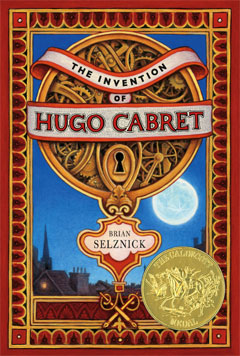 So I saw the movie Hugo and thought to myself, I bet that was a book! And looky here, it is! Now to the unfortunate part...I should have read the book first (always a must). The whole time reading (which only takes about 2 hours since most of the book is in black and white drawn pictures), I kept wondering how the Station Inspector's romance was going to be introduced, when Hugo would hang off the side of the clock, when more images from Georges' movies would be shown...and none of that happened. I should also mention that during the movie, I was thinking about the Smashing Pumpkins' "Tonight Tonight" music video...if you've seen the movie, watch the video and you will understand! Suffice it to say, I think the movie may have been better than the book (the horrors, I know, I don't need to hear it) because of the subplot of the Station Inspector romance it and also because one could see the actual footage of Georges' old movies.
Thursday, April 12, 2012
The Disreputable History of Frankie Landau-Banks by E. Lockhart
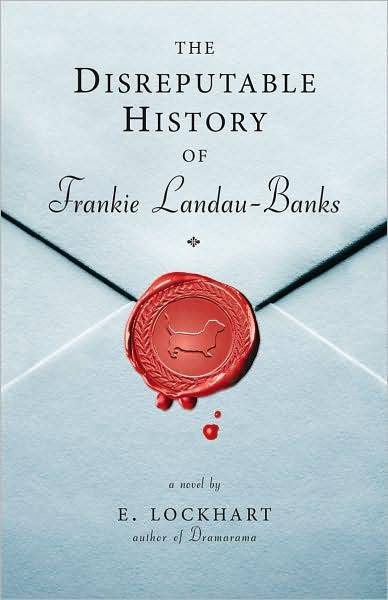 I really, really enjoyed this book, and it was a breeze to read. The story centers around a girl, the titled Frankie Landau-Banks. She attends a boarding (?) school that her father went to starting her freshman year, where she is essentially invisible until she becomes a sophmore with boobs and a boyfriend who happens to be the most popular guy at school (and a senior...gasp!). She is very annoyed, though, because Mr. Boyfriend keeps ditching her for his friend Alpha on a oh-too-regular basis, so one night she follows him and discovers that the secret male society that her father randomly referenced being a part of is actually true, with her boyfriend and Alpha as the Kings. She knows her father talked about some book of the secret society's, so she goes out to find it, and in the meantime, poses as Alpha online and sets up ridiculous pranks against the school, very a la Looking for Alaska. Her whole point is to show that girls can be just as good as guys when it comes to pranks and that the secret society should not be male-only. I really loved the feminist bent to the story (anything boys can do, girls can do...better), which is something I would not have picked up on had I been an actual teen reader and/or not suddenly wanting to know about feminism and its roots, thank you, Republican Party, for your War on Women.
 Wednesday, April 4, 2012
Catfight: Women and Competition by Leora Tanenbaum
 I really really really enjoyed this book. My only caveat is that it is 10 years old, so Facebook is known as the "face book" (that is verbatim from the book). Tanenbaum does a wonderful job of exhibiting why and how women compete against each other in the realms of beauty, dating, careers, and motherhood. Since it was written before Facebook became a household name, it would be interesting to see how the book would change if it were updated today. Facebook has become the ultimate in competition--I, personally, have been Facebook-free for almost three months and life has gotten a lot better. I would spend so much time on it, essentially comparing myself to all my friends and acquaintances daily. I saw who started a relationship, who ended one, who got engaged, married, had a baby, graduated, owned a house, etc., and always felt that my life did not measure up. But it measures up just fine for me right now, since I no longer constantly compare myself to people I rarely see in real life, let alone people who truly matter on a daily basis (that is not to say that I compare myself to people I see every day). I definitely recommend this book (and sorry about the Facebook tangent)!
Fahrenheit 451 by Ray Bradbury
 Since I enjoy dystopian novels, but had not read this, I decided to give it a whirl. The book is definitely over 50 years old, and goes on a lot of seemingly random tangents (that still seem random thinking about them right now...). The book centers around Guy Montag, a fireman who sets books aflame. Books are feared since they breed ideas, and society has been set up in such a way that not much thought is used. I found the story odd and difficult to get in to. I don't much recommend it, such there was not much for plot or character development. Everything pretty much centered around the downfall of society and how books are not really evil things and should not be outlawed or burned.
Monday, March 26, 2012
Why We Broke Up by Daniel Handler
 Obviously, as a reader, you know how this book ends, so the story is really why they broke up. Minerva (goes by Min) has a box of mementos from her relationship with Ed (honestly, what girl doesn't collect things like that, or maybe it's only during their first relationship, like me). The whole story is her going through each item in the box, starting with the beer caps from the first time they talked and he asked her for her number, to the rose petals lining the bottom of the box, obtained from the florist during the break up. It is a compelling story and will make everyone remember their first love and the pain they felt during that time of betrayal/loss. I thought this book was very interesting, and also sad, and kind of odd that it is told from the POV of Min while the author is a male, but whatev.
Wednesday, March 21, 2012
Robopocalypse by Daniel H. Wilson
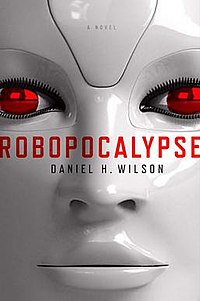 Robots. Apocalypse. Robopocalypse. The book is told in a unique way, with each chapter prefaced and suffixed (?) with Cormac's account of the "New War," where a Rob named Archos became active and directed all robots to attack humans, or at least told them that humans and Robs couldn't coexist (and other Robs believed him). At first, the book is very confusing, starting with seven different accounts pre-New War, and each part (there are five parts to the book) having less and less accounts, directly corresponding with the storytellers who have died due to the New War. Eventually, some humans meet up with some Robs who are "free" aka not under Archos' rule and are willing to help humans defeat Archos. At first when I was about 100 pages into this book, I was so scared. People say Stephen King is horror (and I have read my fair share of SK)? Pfft! Not compared to the dreaded thought of cars and robots and computers and cell phones and everything technological developing its own free will and deciding to use it against humans! Man it had me up at night thinking of these things and what would humans really do if something like this actually happened. Because...you never know...
Sunday, March 11, 2012
Room by Emma Donoghue
 Room is told from the point of view of five-year-old Jack. The story is very Jaycee Dugard-inspired. Jack's mother (forever referred to as "Ma," her proper name is never revealed) is lured to help a man (known as "Old Nick") find his "missing dog," or so Old Nick tells her, when she is 19. She is then kidnapped and held in an 11' x 11' soundproofed garden shed which is called Room. Old Nick holds her and rapes her, leading her to bear a child who is stillborn, and then she has Jack a year later. She tries very hard to make Room an environment for a growing boy, but when Jack turns 5, she tells him hard truths, like what happens "in TV" is actually real (instead of letting him know the truth and not understand why he couldn't partake in it). With this knowledge, she comes up with a plan to save both of them and that requires Jack to be "sick" and then "die" from the sickness, leaving Old Nick no choice but to remove his "body" from Room. While en route to a burial spot, Jack escapes from the rug and is rescued, and helps lead the police back to Room to save Ma. The rest of the story is about Jack adjusting to life Outside of Room and dealing with all it has to offer (such like what happens when one "pets" bees). It was a very good story, I can see why it's been so popular.
 Thursday, March 8, 2012
The Grapes of Wrath by John Steinbeck
 If you are looking for a book to curl up in the bathtub with and have your razor and Death Cab for Cutie handy, this is the book to do the job!!! It is set during the Dust Bowl and is about Tom Joad who just got out of prison. He returns home to his family in Oklahoma and finds that they are leaving to go to California to get some jobs that they've seen in handbills. He goes with them and along with the way, some family members die. They eventually make it to California where they find that they are not wanted (and are called "Okies," similar to the N-word for African-Americans) and that jobs are sparse. What jobs they can find pay "starvation wages," so essentially everything they make in a day goes directly to buy food and not much else. More bad things happen, and then more bad things, and then the book ends. If you are looking for something uplifting, do NOT read this book. Grab yourself a box of tissues instead.
Saturday, February 25, 2012
The Lonely Polygamist by Brady Udall
 I thought this was one of the funniest books I have ever read! Obviously, it is touchy material--it is about polygamy and the author is a Mormon--but one of the children, Rusty, is hilarious! A lot of his chapters, told from his eleven year old vision of the world, reminds me of A Christmas Story, when Ralphie has his daydreams about protecting his family with his coveted Red Rider BB gun. That kind of funny. So the story is about Golden, a man with four wives and 28 children, who has a failing construction business and lies to everybody about his current work project. Everyone thinks he is building a senior center in Nevada (lives in Utah, so no one goes to check the facts), but he is really building a brothel, Pussycat Manor II. Inevitably, he stumbles upon the brothel owner's wife (Huila) and they spend time together and he falls for her. But all hell breaks loose when Ted Leo (said brothel owner) finds out. Golden's past is expolored, and the author uses a significant amount of foreshadowing, which isn't obvious at the time, but makes it a good reflection at the end of the novel. It is so sad that this book has only been checked out four times--including my reading--since being available at the library since June, 2010. It is definitely not a book to miss, and introduces one to the theology behind polygamy and why this belief system is still kept even today.
Subscribe to:
Posts (Atom)